


- Posted On: 05 Aug 2026
-

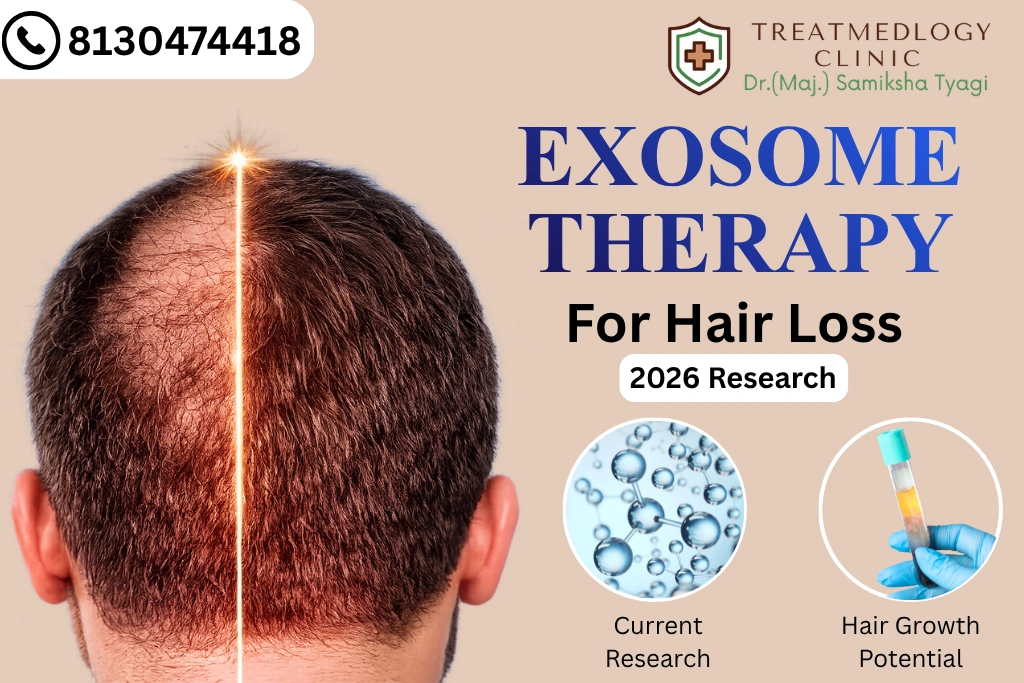
Exosome Therapy for Hair Loss: What Current Research Really Says 2026
Everyone is Talking About Exosome Therapy – But What is the Truth?
Currently, Exosome therapy is a hot topic. It's going viral on social media, in clinics, and also in advertisements as the latest solution to hair loss. Some clinics even suggest that PRP and GFC are outdated therapies while Exosome Therapy is the ultimate cure.
But is that really true?
The purpose of this article is not to promote or dismiss Exosome Therapy, but the objective of this article is simply to tell you what current science actually says in simple terms.
In reality, exosomes are probably one of the most exciting advances in regenerative medicine. Initial research is encouraging however, scientists also acknowledge that it will take more high-quality clinical trials before exosome therapy can be established as a proven standard treatment for hair loss. (Source)
What are Exosomes?
Think of every cell in your body as a mini delivery system.
If a cell wants to communicate with another, it puts some important information in a small package and sends it.
The parcel is called an Exosome.
Think of it like: a WhatsApp message between Cells.
This small package consists of:-
- Growth factors
- Proteins
- Messenger RNA (mRNA)
- Lipids
- Other signaling molecules
These include cell signaling molecules that assist the cells with communicating, repairing damage, decreasing inflammation, and normal healing processes. Exosomes themselves are not living cells - they are small biological communicators secreted from cells. (Source)
What Does Current Research Say?
Exosome Therapy is among the most promising and explored fields of regenerative medicine.
There are positive results in some laboratory studies and early clinical studies concerning:
- Increased hair follicle activity
- Improved follicle cell proliferation
- Enhanced hair shaft thickness
- Potential stimulation of dormant follicles
Vast amounts of data from preclinical and small-scale human studies (https://pmc.ncbi.nlm.nih.gov/articles/PMC11232880/) have been published in the international journal molecular sciences, stem cell research & therapy, regenerative medicine journals, and more.
However, an important fact remains:
Exosome therapy is still under investigation
Potential benefits are suggested by current evidence, but research continues:
- Long-term safety
- Standardized protocols
- Optimal dosage
- Frequency of treatment
- Comparative effectiveness versus PRP and GFC
- Whether results are consistent across different patient groups
However, most experts agree that there is still a need for larger randomized clinical trials before exosome therapy can be considered an established treatment for hair loss.
Exosomes vs PRP vs GFC
People are looking for hair loss treatment in Noida, Delhi, and Delhi NCR, and they do want to know how exosomes are different from PRP and GFC.
| Feature | PRP | GFC | Exosomes |
| Source | Patient’s blood | Patient’s blood + growth factors | Laboratory-derived extracellular vesicles |
| Evidence level | Well-established | Growing evidence | Emerging evidence |
| Regulatory acceptance | Widely used | Widely used | Still evolving |
| Research status | Extensive | Moderate | Ongoing |
| Hair loss applications | Common | Common | Investigational but promising |
Remember that exosomes should not automatically be considered an alternative to PRP Treatment in Noida, GFC Treatment in Delhi, or Hair Transplantation. Different indications and scientific validation levels apply to each treatment.
Who is Suitable for Exosome Therapy?
Research till now indicates that exosomes might be explored for:
- Early-stage hair thinning
- Male pattern hair loss
- Female pattern hair loss
- Diffuse hair thinning
- Hair quality improvement
- Supportive therapy after hair transplant procedures
However, the appropriate treatment changes from patient to patient.
People with advanced baldness, extensive follicle loss or long-lasting bald areas may still need hair transplant surgery in combination with regenerative therapies.
What are the Advantages of Exosome Therapy?
Researchers are finding the most promising benefits of using exosome therapy:
1. Cell-Free Regenerative Approach
Exosomes do not involve transplantations of live cells.
2. High Biological Activity
They have many signalling molecules to repair the tissues.
3. Minimally Invasive Procedure
The treatment is usually administered by means of scalp mesotherapy.
4. Potential Combination Therapy
Future treatments may also use exosomes in combination with PRP, GFC, microneedling, or hair transplant procedures.
5. Scalp Rejuvenation Potential
Exosomes appear to also have a role in creating the optimal follicular environment.
What are the Limitations of Exosome Therapy?
Current limitations include:
- Lack of universal treatment standards
- Variable product quality between providers
- Limited long-term human studies
- Different manufacturing processes
- Regulatory differences across countries
- Ongoing need for clinical validation
Patients should be cautious of exaggerated claims such as:
- Guaranteed permanent hair growth
- Instant reversal of baldness
- In every scenario, an alternative to hair transplant
- 100% success rates
At the moment, there is not a single scientific study confirming these statements.
Exosome Therapy for Hair Loss in Delhi
Dr Samiksha Tyagi, an expert Plastic and Cosmetic Surgeon with 15+ years of experience, years of experience, thinks evidence-based patient education & personalized treatment planning is the way to go for better outcomes at Treatmedlogy Clinic. In conclusion, in this highly complex field of regenerative medicine that is still evolving, patients should undergo proper scalp and hair assessment before considering more advanced treatment options such as PRP, GFC, exosomes, or hair transplantation.
Final Thoughts
Exosome therapy is one of the most exciting waves in hair regeneration medicine. Exosomes, based on initial scientific studies, may increase the bioactivity of scalp science as well as improve the quantity and quality of follicles by increasing hair density with several of these approaches. Also, specifically in that context, it is just as important to acknowledge that exosome therapy is still developing with active studies evaluating its long-term impact, safety, and reproducibility by researchers across the globe.
Exosomes could become a key factor in future therapy approaches targeting hair restoration to obtain a denser head of hair, healthier scalp, and beautiful hair – the kinds of characteristics that help create a youthful, confident appearance.
Want to learn more about advanced hair restoration options in Noida, Delhi NCR? Call or WhatsApp +91 7827755854 for expert guidance and personalized consultation.